





In brief
Where the 21-day myth comes from
The number comes from a book from the 1960s: a plastic surgeon, Maxwell Maltz, observed that his patients took "a minimum of about 21 days" to get used to their new appearance. Passed from mouth to mouth, "a minimum of 21" became "21 is enough": the minimum turned into a guarantee. It's the fate of many round numbers: they travel better than the sentence that contained them.
What the 66-day study actually measured
Phillippa Lally and her team followed 96 volunteers for twelve weeks as they took on a small new daily habit - drinking a glass of water, going for a walk, eating a piece of fruit - measuring how long it took for the action to become automatic. Median: 66 days - not the mean, and it's a difference that matters, because the very few very slow cases would have pulled the mean much higher. The most interesting finding, though, is the spread - from 18 to 254 - and one experimental consolation: skipping a day now and then didn't wipe out the progress. Habits aren't a house of cards.
The anchor is everything
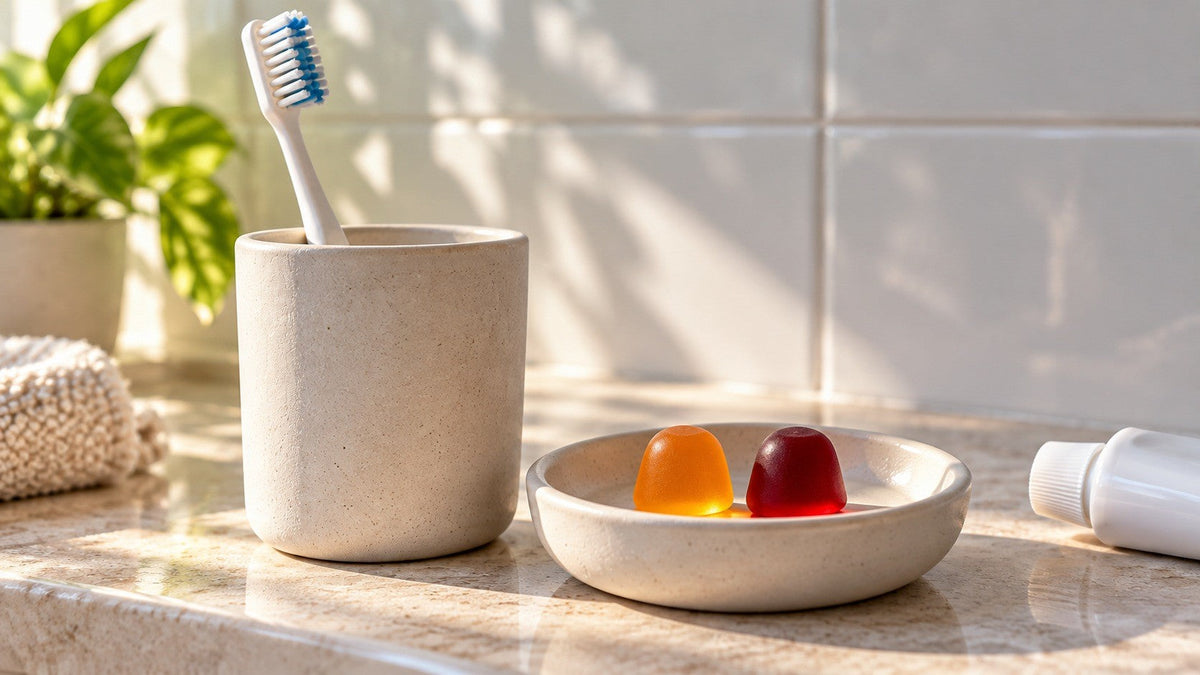
Habit research converges on one practical point: a new action takes root more easily when it leans on a cue that's already there. That's why the Yfact ritual doesn't ask for set times, alarms or reminders: it hooks onto the two most reliable moments of the day - when you wake up and when you go to bed. You don't have to remember the gummy: it's waking up that reminds you.
Why the jar lasts 30 days
So what about our 30 days? They're two precise things: the directions for use on the label, which say (in Italian) "for at least 30 consecutive days", and the size of the jar, 60 gummies, exactly one month. They're not the promise of a result on day 31: they're how long the action lasts as it was designed, and the reason the subscription delivers every month - because a ritual shouldn't be interrupted by an empty jar.
Sources
- Lally P., van Jaarsveld C. H. M., Potts H. W. W., Wardle J. (2010). How are habits formed: Modelling habit formation in the real world. European Journal of Social Psychology, 40(6), 998-1009. https://doi.org/10.1002/ejsp.674

From the magazine to the jar
Focus & Relax
For the mind
From €19,99 a month, with a subscription
See what's insideThis box is about our products: consider it promotional. The article above remains editorial.
This article is for informational purposes and does not replace a doctor's advice. Food supplements should not be used as a substitute for a varied and balanced diet and a healthy lifestyle.


Leave a comment
This site is protected by hCaptcha and the hCaptcha Privacy Policy and Terms of Service apply.